Welcome B.W.S
Invest for purpose not money....
Relational- The relationships in our lives affect how we think, feel, and behave with money. Immediate and extended family, friends, coworkers, and clients influence how we perceive and understand the role money plays in our lives.
Cognitive- Cognitive refers to what we consciously know, think, and believe. It can also relate to our unconscious beliefs and biases about money.
Emotional- Emotions influence our cognition, behavior and relationships with others around money. Likewise, how we think, behave, and relate to others regarding money impacts our emotional responses. Emotional reactions to money can be expressed and maintained in our relationships with others and in our mind-body connection between our thoughts and beliefs and our physical bodies.
Behavioral- Our behavior is the manifestation and expression of our emotional, cognitive, and relational realities. Emotions and thoughts about our behavior are interrelated where a change in behavior can result in a change in thoughts and emotions, and a change in thoughts and emotions can create behavior change.
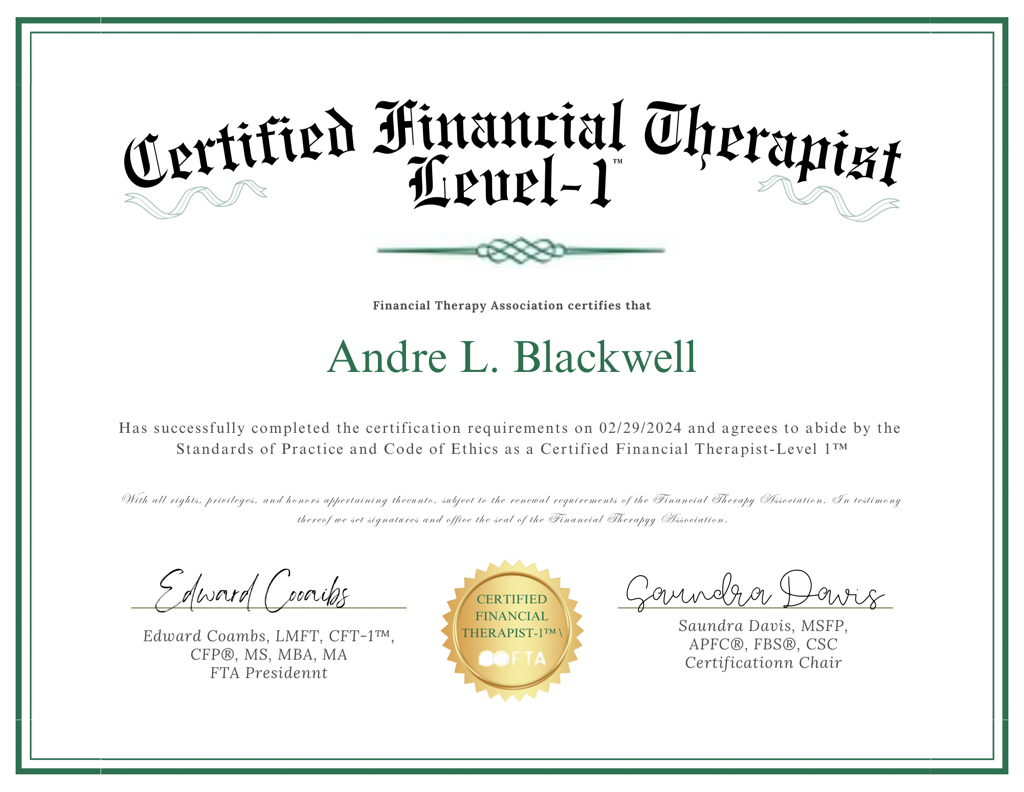
Financial- Money is a complex tool that is both objective and subjective. It is emotionally charged and loaded with conscious and unconscious beliefs that not only reflect our financial health but our personal well-being and the quality of our interpersonal relationships. Financial therapy intervenes in one or more of these areas (cognitive, emotional, behavioral, relational, financial) to make a positive difference in our lives.
Cognitive- Cognitive refers to what we consciously know, think, and believe. It can also relate to our unconscious beliefs and biases about money.
Emotional- Emotions influence our cognition, behavior and relationships with others around money. Likewise, how we think, behave, and relate to others regarding money impacts our emotional responses. Emotional reactions to money can be expressed and maintained in our relationships with others and in our mind-body connection between our thoughts and beliefs and our physical bodies.
Behavioral- Our behavior is the manifestation and expression of our emotional, cognitive, and relational realities. Emotions and thoughts about our behavior are interrelated where a change in behavior can result in a change in thoughts and emotions, and a change in thoughts and emotions can create behavior change.
Financial- Money is a complex tool that is both objective and subjective. It is emotionally charged and loaded with conscious and unconscious beliefs that not only reflect our financial health but our personal well-being and the quality of our interpersonal relationships. Financial therapy intervenes in one or more of these areas (cognitive, emotional, behavioral, relational, financial) to make a positive difference in our lives.